Define your vision.
Agents build the reality.
The self-building application framework where autonomous AI agents scaffold, wire, and extend reviewable Django/React software. Start with a public-alpha stack and grow it addon by addon.
Install the CLI
Requires Docker. View on GitHub
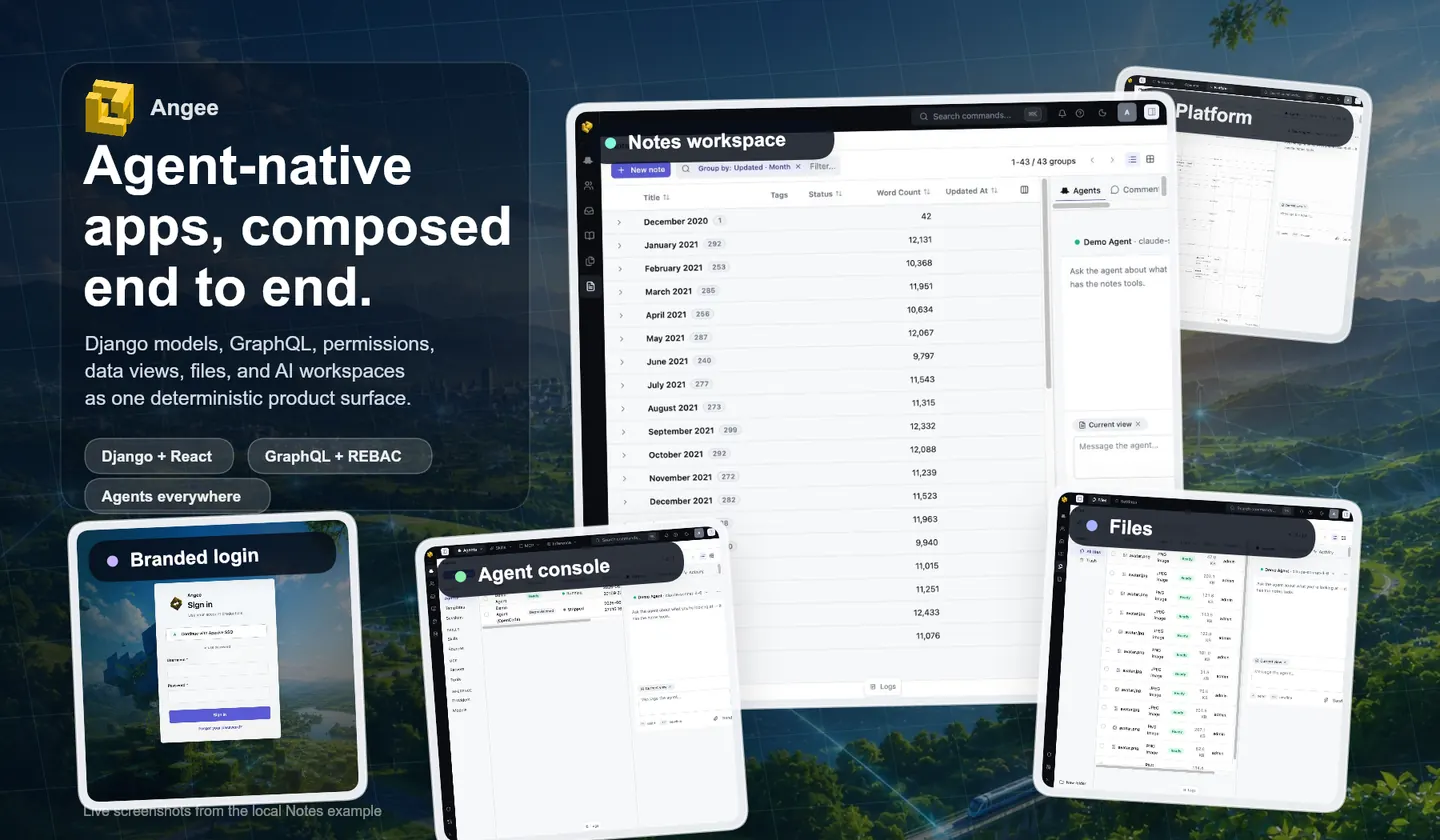
Product snapshots
One workspace, many agent-built surfaces
Notes, files, platform controls, agent sessions, and account flows live in the same composed application shell.
Why teams choose ANGEE
Stop hand-wiring infrastructure. ANGEE ships it solved — then lets AI extend it to anything you need.
Self-building applications
Describe what you need. ANGEE's agents scaffold reviewable Django + React addons — models, GraphQL, permissions, UI, resources, and migrations — against the same contracts humans use.
Zero-config architecture
Addons declare their contracts once. The composer turns those declarations into a runnable project, so routes, schema, resources, and permissions stay deterministic instead of hand-wired.
MCP-native agents
Every agent is a first-class resident with fine-grained permissions, declared capabilities, and per-session grants. Connect Claude, Cursor, or any MCP client directly to your running ANGEE instance.
Enterprise-grade, out of the box
Django 6, GraphQL, REBAC permissions, encrypted fields, typed React, and operator-managed stacks are built in. Self-host today; managed cloud is coming soon.
How ANGEE works
From open-source alpha to a composed platform — then keep extending with AI
Bootstrap
Clone, initialize, run
Clone the open-source runtime, install the ANGEE CLI, and bring up the example stack: auth, REBAC permissions, GraphQL, subscriptions, MCP, and the current base addons.
Compose
Pick your building blocks
Compose base addons such as iam, integrate, agents, mcp, storage, knowledge, parties, messaging, social, platform, and operator. The composer emits the runnable project deterministically.
Extend
Describe it, AI builds it
Need something custom? Describe the capability in natural language. AI agents scaffold an addon, wire it into the platform contracts, and validate it against the schema — you review and ship.
Deploy
Self-hosted or cloud, your choice
The same manifest that runs locally deploys to your own infrastructure — or, soon, to a managed angee.sh instance. The platform can self-update under operator supervision. You stay in control.
Three-layer architecture
Addons, agents, and ecosystem modules compose into one deterministic Django + React runtime
Addons
Modular building blocks
Django apps with source models, GraphQL schema parts, permissions, resources, and React surfaces. Add one to the project and the composer emits the deterministic runtime.
- Build-time composition
- GraphQL + MCP
- REBAC permissions
- React routes + views
Agents
Autonomous AI workers
First-class residents with fine-grained permissions, declared capabilities, and per-session grants. Content redaction, context firewalling, and a full audit trail come standard.
- Permission-scoped execution
- MCP protocol
- Context firewalling
- Full audit trail
Ecosystem
Community-powered growth
Base addons and agent-created modules form a growing library. IAM, resources, integrate, MCP, operator, and platform keep the shared surface consistent.
- Base addon library
- Agent-generated modules
- Shared tool registry
- Composable templates
Platform Architecture
How the layers connect
Who do you trust?
Agents with identities, permissions with no back doors, an audit trail that can't be talked out of — on infrastructure you own.
Growing ecosystem
Pre-built addons for common problems, plus the products built on ANGEE
Platform Core
Included in every installationiamIdentity, the swappable user model, and the REBAC permission hub
resourcesTiered data import/export for master, install, demo, and seed resources
mcpAuthenticated MCP server at /mcp, exposing addon tools to agents
integrateOAuth connections, credentials, and the bridge/capability runtime
agentsInference provider/model catalogue and the runtimes agents run on
platformAdmin console for schema exploration, addons, and the marketplace board
Addons
Enable what you needmessagingThreads, messages, and channel bridges that ingest mail and social conversations
storageDrives, folders, and content-addressed files with chunked uploads
knowledgeMarkdown-first knowledge base with vaults of versioned pages
partiesPeople, organizations, addresses, affiliations, and directory sync
socialPublic feeds, engagement metrics, following/timeline, and reactions built on messaging
Built on ANGEE
Payloads you canangee upThe endgame
ACM — Agentic Company Management
Business software has always managed things for humans to work on. ACM is what comes after: AI agents that actually run the back office, on a substrate you can read, audit, and own. angee up your business — and the agents take their shift.
CRMCustomer relationship management
Manages your customers. Humans do the work.
ERPEnterprise resource planning
Manages your resources. Humans still do the work.
ACMAgentic company management
Agents operate the company — bookkeeping, invoicing chase, procurement, pipeline hygiene — under structural permissions, with human approval gates.
Every company gets an AI back office. The one they can trust is the one they can read.
Battle-tested tech stack
Built on proven open-source foundations — best tool for each layer, no proprietary lock-in
Backend
Frontend
Infrastructure
Pricing that scales with you
Start free with self-hosting. Move to angee.sh managed instances when you want the convenience.
Open Source
Full framework for teams with in-house DevOps
- Complete source code access
- Docker Compose deployment
- All core apps & agent framework
- Community ecosystem apps
- Community support
- Bring your own LLM
angee.sh
Managed ANGEE instances — your payload, our operations
- One command from repo to running instance
- ARPEE or fyltr payloads — or your own addons
- Compute-priced workspaces, never per-seat
- Backups, SSO & team management
- Managed updates & monitoring
- Sovereign / BYO-cloud tier planned
Enterprise
White-glove deployment with compliance controls
- On-premises or private cloud
- Role-based access policies
- Audit logs & compliance tools
- Dedicated account manager
- Custom integrations & SLA
- Training & knowledge transfer
Frequently asked questions
Everything you need to know about ANGEE
What exactly is ANGEE?
How is this different from other AI coding tools?
What is MCP and why does it matter?
What tech stack does ANGEE use?
Can I use my existing code with ANGEE?
How does "extend with AI" actually work?
Is ANGEE really fully open source?
What is ACM (Agentic Company Management)?
What is angee.sh?
Can I use ANGEE in production?
Ready to let agents build for you?
Angee is already open source in early alpha. Join the update list for release notes, addon progress, and managed-cloud news.